As far as we know, there is no definite answer as to why
the game of golf is so called. The term seems to have originated
from the old Scots words golve, gowl or gouf and is possibly borrowed
from medieval Dutch (colf being club and “spel metten colven”
being game (played) with club - this was a Dutch game resembling
golf). As time has passed, the name has remained and been refined
to golf, as we know it today. You will still hear older Scottish
golfers refer to the game as the Gowf, keeping the older Scots name
in use. Indeed, a golf club in Ayrshire is still called Loudoun
Gowf Club today.
When did golf begin?
The earliest known reference to golf dates to 1457, when King
James II of Scotland banned golf and football on the grounds that
they where keeping his subjects from their archery practice. The
ban was repeated in 1471 by James III and in 1491 by James IV
for the same reason.
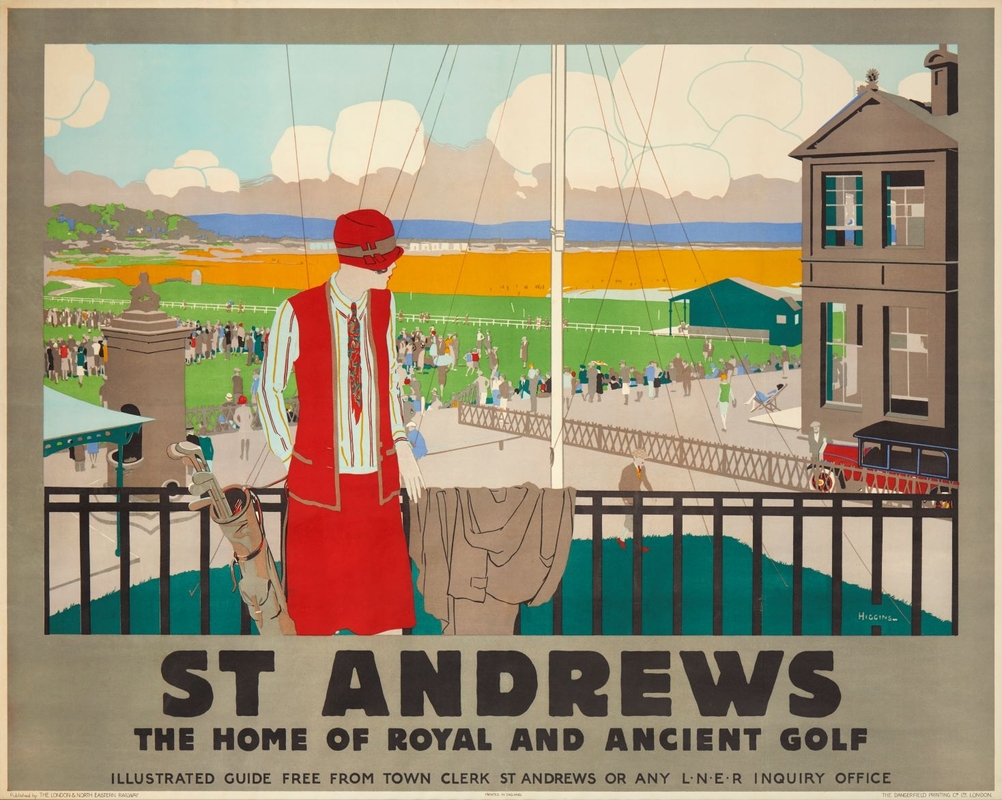
When did golf in St. Andrews begin?
The first surviving written reference to golf in St. Andrews is
contained in Archbishop Hamilton’s Charter of 1552. This
reserves the right of the people of St. Andrews to use the linksland
“for golff, futball, schuteing and all gamis”. As
early as 1691, the town had become known as the “metropolis
of golfing”.
What does LINKS mean?
A golf links is a stretch of land near the coast characterised
by undulating terrain, often associated with dunes, infertile
sandy soil and indigenous grasses such as marram, sea lyme and
the fescues and bents which, when properly managed, produce the
fine textured, tight turf for which links are famed.
The course rota used for the Open Championship is made up of Links
golf courses.
Why are there 18 holes on a golf course?
Initially, there was no standard number of holes on a
golf course. St Andrews for example had 22 holes until about 1764
when 4 were merged to make an 18 hole course. As far as we can
establish, there is no specific date for when 18 holes became
the standard number of holes on a course. In 1858, the R&A
issued new rules for its members; Rule 1 stated:
“one round of the Links or 18 holes is reckoned a match
unless otherwise stipulated”.
We can only presume that, as many clubs looked to the R&A
for advice, this was slowly adopted throughout Britain. By the
1870s, therefore, more courses had 18 holes and a round of golf
was being accepted as consisting of 18 holes.
Why is BOGEY so called?
The term originated from the mythical golfer, Colonel
Bogey, a player of high amateur standard who was held to play
every hole of a given course in the standard stroke score. The
meaning of the term has changed over the years. It is now most
commonly used to denote a score of one stroke over par, but was
originally the target score that a good amateur should achieve
on a given course. In the same way par became associated with
the target score for professionals. For a while the two terms
were interchangeable until par became the standard term.
What does PAR mean?
The dictionary definition of the word par is usual or
average. It is, therefore clear why it was adopted by golfers
to mean the standard score in strokes for each hole of a given
course. The term was mentioned in 1891 in Golf magazine as follows
"the result was satisfactory to the handicappers, as the
par of the green for gentleman ... was nearly attained by three
couples." This would indicate that the term was in use by
this time.
And BIRDIE, EAGLE and ALBATROSS?
As with many terms used in golf, the exact origins are
not known. The term birdie seems to have been accepted into common
usage over a period of time. The term appears to have originated
from the phrase "a bird of a shot." In US slang a bird
was used to exclaim that something was wonderful or excellent.
When used by golfers it may have implied that the ball "flew
like a bird." The term seems to have been in use by the 1910s.
The terms eagle and albatross where coined as an analogy with
birdie. As the score under par increases so does the size and
rarity of the bird. Eagle is two under par and an albatross refers
to 3 stokes under.
Why do golfers shout FORE?
As is often the situation with questions about the origins
of golfing terms, there really isn't a definite answer. It seems
that the term fore has some relation to the forecaddie. The forecaddie
was a person employed to go ahead of players to mark the lie of
balls in play. It may be that, over time, the word forecaddie
was shortened when yelled as a warning to this person and the
word has remained in use since. In 1881, Robert Forgan in his
book, The Golfer's Handbook, makes the following reference "...shouts
"Fore!" to give the alarm to anyone in his way."
indicating that the term has been used for a long time.
Why are CADDIES so called?
This word has a number of possible origins. It may have
derived from the French word cadet which means youngest. Traditionally
the youngest son of the family would join the army, and the word
became associated with army cadets. The word was borrowed into
most European languages. In 18th century Scotland, particularity
Edinburgh, there were men who hired themselves out as odd-job
men and messengers. As many of them had previously been in the
army they became known as caddies meaning “gentlemen freelancers
or non-commissioned officers” in distinction from a regularly
employed private servant.
How valuable is my golf club?
If you have any golfing items and would like to find
out if they are worth anything, you will need to contact an auction
house. The Museum is unable to provide valuations. If you require
historical information, please contact the Museum with a detailed
description of your golf club including a photograph.