British Golf Museum
Scottish Tourist Board


  Long Nosed Clubs    
 
Peter Lewis, Director of the British Golf Museum at St Andrews and curator Fiona Grieve trace the development of golf clubs, starting with the long nosed clubs.

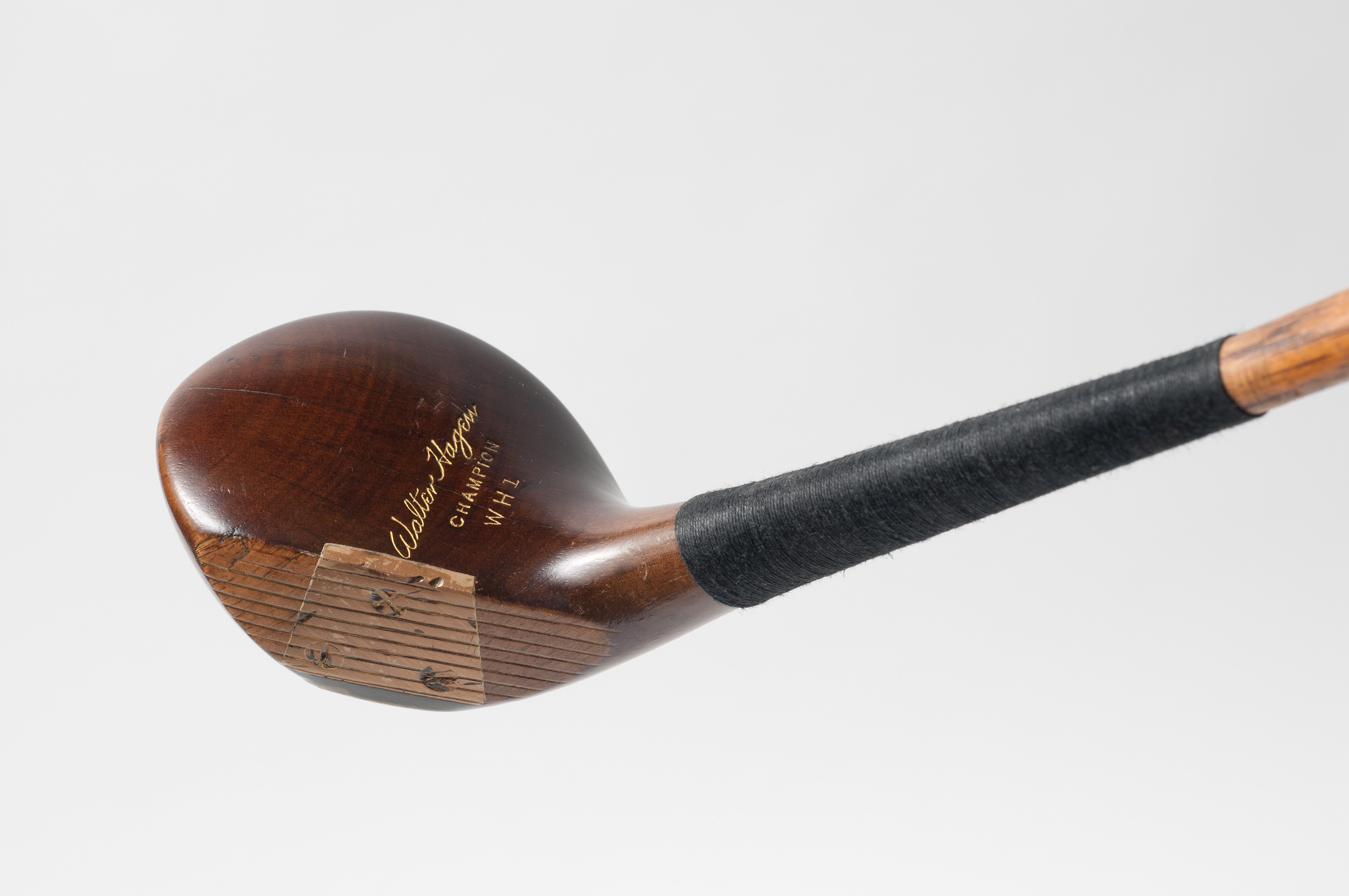
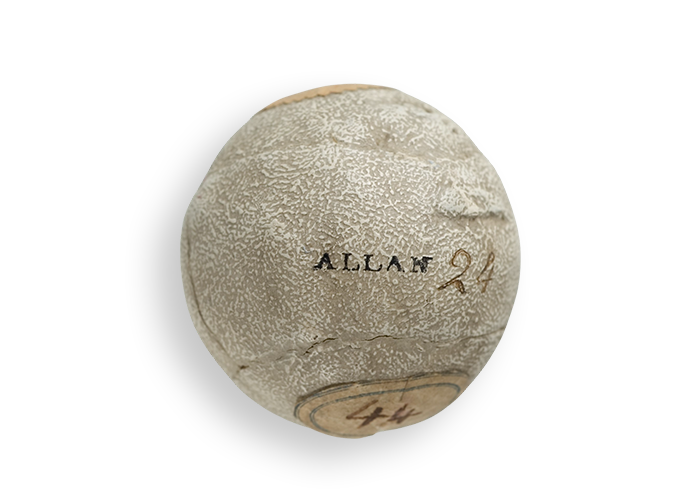
The long nosed clubs, played with throughout the era of the feather ball, looked much as its name suggests. It had a long slender shape and was a shallow face. The striking face was convex. Additionally, the upper surface of the head was domed. Different woods were used to make the heads and the shafts. While club makers experimented with many different woods, including apple and holly for the heads, they had by the late eighteenth and early nineteenth century settled on the blackthorn and beech.

In the 1820s Britain began to import hickory from the USA. Originally intended for pit props and exe handles, it soon became clear that, if treated correctly, it was ideal for golf club shafts.

The joint along the long nosed club was a scared joint. Adapted from the techniques used by ship wrights, the head was cut with a long nose neck ad, most importantly, the grain of the wood ran up the neck of the club. The back surface of the neck was shaped as a flat, slanting surface and was matched by a similar surface on the lower end of the shaft. The two were glued together and bound with whipping. A coating of pitch was then applied to protect the joint from the weather.

The earliest long nosed club had a very straight, shallow face. Gradually, however, club makers began to produce clubs with different lofts and shaft lengths. The Play Club or Driver was used for shots from the tee. A range of Spoons- Long, Middle, Short and Baffy- were used for fairway shots and approach shots to the green. Irons were used only as a last resort. During this period they were crudely made and could easily split the feather ball. A Cleek of Iron was used as a general purpose club, and Track and Rut Irons were used to extract the balls from exactly such hazards, which were not uncommon on the golf courses at this time.

The six woods and two irons which form the Troon collection provide perhaps the earliest examples of the long nosed club. Found in a house in Hull in 1898, the woods are thought to date from the early eighteenth century and the irons from the late seventeenth. Sadly, although the woods have what is thought to be a maker’s mark on them, nothing is known about he club makers who produced them.

One of the earliest club makers about whom some information has survived is Simon Cossar. Possibly based in Leith, he was producing long nosed, scared head golf clubs during the second half of the eighteenth century. Around the same time James McEwan also made well crafted, long nosed clubs in Edinburgh. His sons continued his business.

Among the next generation of club makers the name of Hugh Philp is perhaps one of the best known. He began repairing clubs in 1812 and in 1819 was appointed club maker to the Society of St Andrews Golfers (later the Royal and Ancient Golf Club). He was a club maker of consummate skill, whose clubs are considered to be among the best ever crafted. On Philp’s death, Robert Forgan, who was related to Philp by marriage, took over the club making business and continued to produce clubs for the remainder of the nineteenth century. In 1863 he became club maker to the Prince of Wales, later Edward VII.

All these club makers at least began their club making careers in the age of the long nosed club. Having survived for more than a century, this style of club began to disappear after the introduction of the gutta percha ball circa 1848. the new ball was much more resilient and the impact was twofold. Firstly, the shape of the wooden club changed and, secondly, golfers were increasingly able to use irons in their play. In order to play the gutta percha ball effectively., the club head became shorter and the neck of the club thicker and stronger.

The transition was gradual, and the new shape, which is not dissimilar to the shape of the conventional driver today, did not really appear until the 1890s. The brassie was introduced around this time. Roughly equivalent tot his modern three wood, it had a brass sole screwed to the base of the club which protected it from hard surfaces.

During the transitional period the club still tended to have a scared joint but gradually the socket joint was introduced. In this joint the shaft travels through the neck of the head, which was drilled to receive it and can be seen on the sole.

With the ever increasing popularity of golf, the demand for club grew. The socket joint clubs could be mass produced . Production was therefore quicker and more cost effective fort the club makers.

The harder gutta percha ball meant that irons became more useful to the golfer. It was easier to loft a gutta percha ball with an iron than with a spoon. Thus, the design of the iron became more sophisticated with the mid iron, the mashie and the niblick replacing the spoons. While the golfer had carried mainly woods, with perhaps one iron, the situation began to reverse.

The rise of the middle class, the growth of the railway and the increasing leisure time ensured games such as golf became increasingly popular towards the end of the nineteenth century. As a result, there was an explosion of interest in designing clubs to assist the player in this most irksome of games. There was no body regulating such designs. The Royal and Ancient Golf Club’s Rules of Golf Committee, formed in 1897, did not legislate on club design until 1909.

New club designs included a wide range of adjustable headed clubs, such as the Urquhart Adjustable Head Club of circa 1895. The angle of the club head, through this design, could be altered to suit the shot. Some clubs had detachable heads, This meant the player could carry one shaft to which different heads could be attached, thereby reducing the number of clubs the player had to carry. At a time when the number of clubs used was unrestricted, this was a useful invention.

Other clubs had a spring mechanism inserted in the face. Some were of simple design with a cavity in the face covered by a thin plate of steel. Others were more complicated.

A.H. Bryng patented a design in 1904 which comprised a series of laminated plates of varying sizes which could be attached to the club face.

The other notable design of this time was the centre shafted club such as that patented by Robert Anderson in 1892. In 1897 F.W. Brewster patented the “Simplex” torpedo club, which was described in the patent as being “of the boat-like shape slightly narrowing from its mid cross section towards the striking face”. In 1903, Arthur F Knight patented his Schenectady putter, a club used to great effect by Walter J Travis in the 1904 British Amateur Championship.

William Mills, who produced a whole range of aluminium clubs based on the long nosed clubs, also patented dual faced clubs, which were quickly termed “Duplex”.

Between 1909 and 1910 any clubs which featured mechanical contrivances of centre shafts were banned by the Rules of Golf Committee.

The next major landmark in the development of the golf club was the introduction of the steel shafts. First advertised in 18901, they were just one of the myriad of different inventions in golfing equipment.

In 1911, some 20 years after first being advertised, the idea of steel shafted clubs was put before the Rules of Golf committee. It was rejected. The idea again failed to gain approval in 1913.

In 1926, the United States Golf Association accepted the use of steel shafts an din 1929 the R&A followed suit.

In order to ease the introduction of the steel shaft to a conservative golfing public, the earliest steel shafts where coated to resemble hickory. Steel shafts allowed the weaker players to hit the ball further and the clubs were more reliable. As a result the manufacturers began to produce matched sets of clubs.

In 1938 the USGA decided to limit the number of clubs which could be carried to fourteen. In 1939 the R&A did the same. By the outbreak of World War II, with the exception of putters, hickory shafts had been largely superseded by steel.

 
HOME | NEWS | THE GALLERIES | VISITOR INFO | KIDS SECTION | SNAP SHOTS | FAQ | HISTORY | LIBRARY | ENQUIRY | LINKS

© 2001 BRITISH GOLF MUSEUM